
A LinkedIn outreach campaign for consulting firms is defined as the structured process of using targeted, personalized LinkedIn interactions combined with authority content to generate qualified client conversations. This is not mass prospecting. The industry term for this approach is “social selling,” and it works best when credibility precedes contact. Consulting firm owners who treat LinkedIn as a cold-calling tool consistently underperform those who build visible expertise first, then reach out. The goal of any well-run campaign is not connections. It is qualified conversations booked within a 30–60 day window, which reflects the reality of B2B consulting sales cycles.
What prerequisites do you need before launching your LinkedIn outreach campaign?
The groundwork you lay before sending a single message determines whether your campaign builds pipeline or burns your reputation. Most consulting firms skip this phase and wonder why their acceptance rates are low.
Define your ideal client profile first. Precision matters more than reach. Identify the exact job titles, company sizes, industries, and triggering events (such as funding rounds, leadership changes, or regulatory shifts) that signal a prospect is ready for your services. A boutique operations consultancy targeting “VP of Operations at Series B SaaS companies with 50–200 employees” will outperform one targeting “business leaders.”

Build your authority content foundation. Authority content published before outreach converts cold connection requests into warm reads. Post at least four to six pieces of thought leadership content on your LinkedIn profile before you begin outreach. These can be short-form posts, articles, or frameworks that demonstrate your point of view. Prospects who see your content before receiving your message are far more likely to accept and respond.
Assemble the right tools. The core stack for a consulting firm LinkedIn campaign includes:
- LinkedIn Sales Navigator: Filters prospects by seniority, company size, industry, and recent activity signals
- A CRM platform: Tracks every conversation, follow-up stage, and outcome (HubSpot and Pipedrive are widely used options)
- Browser-based outreach automation: Runs at human pace to avoid triggering LinkedIn’s spam detection
- A content calendar tool: Keeps your thought leadership publishing consistent
Know the platform’s activity limits. LinkedIn flags accounts that send connection requests too aggressively. The recommended safety cap is 20 connection requests per day. Staying within this limit protects your account and keeps your outreach looking organic.
| Preparation Step | Why It Matters |
|---|---|
| Define ideal client profile | Prevents wasted outreach on low-fit prospects |
| Publish authority content | Warms prospects before first contact |
| Set up CRM | Tracks pipeline and prevents follow-up gaps |
| Configure automation safely | Protects account from LinkedIn restrictions |
| Set daily send limits | Keeps activity within platform guidelines |
How to launch and manage a LinkedIn outreach campaign step by step
Execution separates campaigns that fill calendars from those that generate silence. Follow this sequence to build a compliant, credible outreach motion.
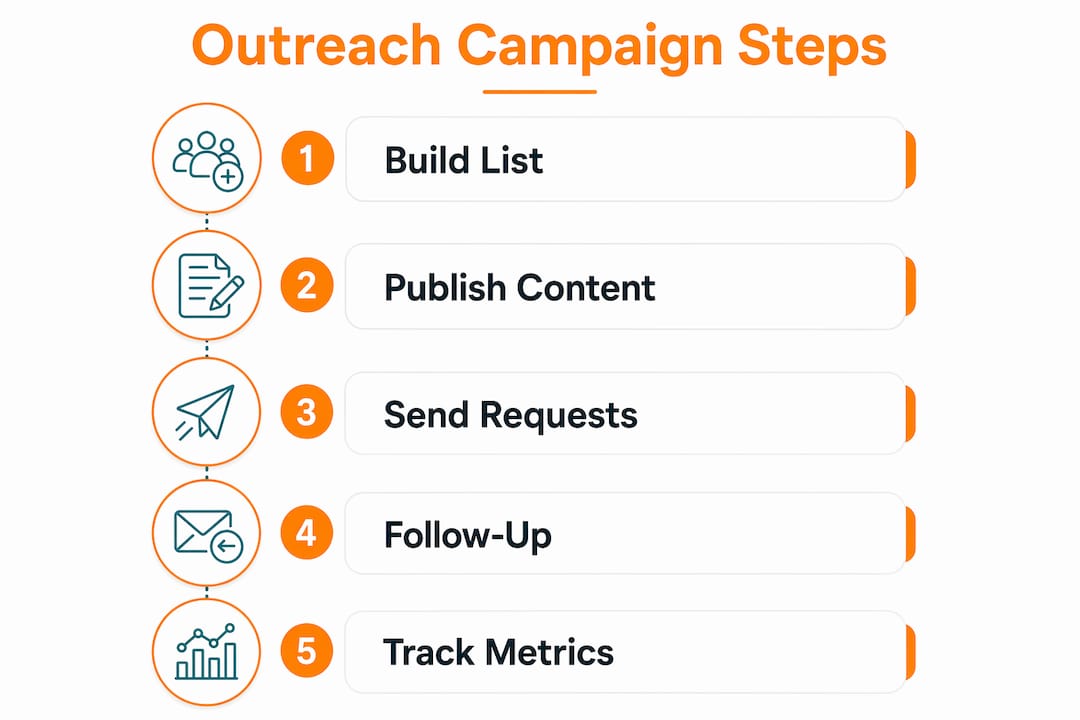
1. Build a targeted prospect list. Use LinkedIn Sales Navigator to filter by job title, industry, company headcount, and geography. Aim for 30–80 deeply researched prospects per week rather than thousands of generic contacts. Targeting precision outperforms broad messaging at every stage of the funnel. Quality of fit predicts quality of conversation.
2. Publish thought leadership content before you reach out. Post two to three times per week in the two weeks before your campaign goes live. Write about problems your ideal clients face, not about your services. A CFO who has already read your post on cash flow forecasting errors is a warmer prospect than one who has never seen your name.
3. Send personalized connection requests. Write a short, specific note with each request. Reference something real: a post they published, a company milestone, or a shared professional context. Personalized connection requests with a peer-to-peer tone generate 2–3x higher acceptance rates than generic InMail. Keep the note under 300 characters and avoid pitching in the first message.
4. Run a multi-touch follow-up sequence. Once a prospect accepts, begin a value-first message sequence. A well-structured sequence of 3–5 messages over 14 days consistently outperforms single-message outreach. Each message should add something useful: a relevant article, a short insight, or a question that opens dialogue. Never pitch until the prospect signals interest.
5. Track the right metric. The primary success metric in the first 30–60 days is qualified conversations booked, not connection count or message open rates. Sales cycles in consulting are long. Measuring immediate revenue from LinkedIn outreach sets the wrong expectation and leads to premature campaign abandonment.
Pro Tip: Schedule 30 minutes each morning for human-work: reading replies, personalizing responses, and booking calls. Use automation only for the system-work: list building, connection requests, and initial message delivery. This split protects your billable hours and keeps conversations feeling genuine.
How to create messaging that builds trust for your consulting brand
Messaging is where most consulting firm campaigns fail. Generic templates signal low effort, and prospects recognize them immediately.
The foundation of effective outreach messaging is specificity. Reference the prospect’s actual context: a recent company announcement, a role change, an industry trend affecting their sector. This signals that you did the work before reaching out, which is exactly the behavior a good consultant demonstrates. Effective LinkedIn outreach is a craft of consultative, personalized messaging backed by visible expertise, not a volume game.
Lead with an insight or outcome, not a service list. Instead of “We help companies with change management,” write “Most mid-market operations teams I speak with are losing 15–20% of project capacity to unclear ownership structures. Happy to share a quick framework if that resonates.” This approach demonstrates expertise and invites dialogue without pitching.
Use anonymized proof points subtly. Mention a framework you developed or a pattern you observed across clients without naming names. This builds credibility without violating confidentiality. For more ideas on content that builds visibility, pairing your outreach with a consistent content strategy multiplies the effect.
“LinkedIn outreach for consulting firms works best when the prospect already knows who you are before your message arrives. Authority content is not optional prep. It is the engine that makes every connection request land warmer.”
Keep your tone peer-to-peer, not vendor-to-buyer. Write as one professional sharing a perspective with another, not as a salesperson presenting a solution. Avoid phrases like “I’d love to connect and share how we can help.” Replace them with “Curious whether this challenge shows up in your team as well.”
Key messaging principles to follow:
- Open with the prospect’s context, not your credentials
- Lead with an insight or a question, not a service description
- Include one subtle proof point per message (a framework, a result pattern, or a named methodology)
- Keep messages under 150 words
- End with a low-commitment call to action (“Worth a quick chat?” not “Book a 30-minute demo”)
What are the common challenges when launching LinkedIn outreach campaigns?
Every consulting firm running LinkedIn outreach hits predictable obstacles. Knowing them in advance prevents the most costly mistakes.
Account restrictions from over-sending. LinkedIn monitors connection request velocity. Sending more than 20 invites per day risks a temporary restriction or a permanent flag on your account. Browser-based automation run at human pace reduces this risk by mimicking normal user behavior. Never use direct API-based tools that bypass LinkedIn’s interface.
Time drain on partners and senior consultants. LinkedIn outreach done manually at scale consumes hours that should go to client work. The solution is to separate system-work from human-work. Delegate list building, message sequencing, and CRM updates to a dedicated team member or agency. Reserve partner time exclusively for qualified conversations and relationship development.
Low response rates from poor targeting. If your acceptance rate is below 20% or your reply rate is below 5%, the problem is almost always targeting, not messaging. Revisit your ideal client profile and tighten the filters. Narrow by industry, seniority level, and company stage before adjusting message copy.
Scaling while maintaining personalization. As campaigns grow, personalization quality tends to drop. Use a tiered approach: write fully custom messages for your top 20 highest-fit prospects each week, and use lightly customized templates for the remaining 60. This preserves quality where it matters most.
Additional troubleshooting tips:
- Review CRM data weekly to identify which prospect segments convert to conversations
- Pause sequences for prospects who have gone cold after three messages
- A/B test your connection request notes monthly to find what resonates with your niche
- Use lead nurturing strategies to keep warm prospects engaged between outreach touchpoints
Key Takeaways
A successful consulting firm LinkedIn outreach campaign requires authority content, precise targeting, and a disciplined message sequence that prioritizes qualified conversations over raw connection volume.
| Point | Details |
|---|---|
| Authority content comes first | Publish thought leadership before outreach to warm prospects and increase response rates. |
| Cap daily connection requests | Send no more than 20 invites per day to protect your LinkedIn account from restrictions. |
| Personalization drives acceptance | Peer-to-peer, specific connection notes generate 2–3x higher acceptance than generic InMail. |
| Track conversations, not connections | Measure qualified meetings booked in the first 30–60 days as your primary success metric. |
| Separate system-work from human-work | Automate list building and sequencing; reserve partner time for qualified conversations only. |
What I’ve learned from watching consulting firms run LinkedIn campaigns
The single biggest mistake I see consulting firm owners make is launching outreach before their LinkedIn profile looks like an authority. They send 50 connection requests on day one and wonder why nobody responds. The prospect checks their profile, sees three generic posts from six months ago, and ignores the request. The profile is the first impression, and it has to do the selling before the message does.
The second pattern I’ve noticed is that firms confuse activity with progress. Sending 100 messages a week feels productive. But if those messages go to loosely targeted prospects with templated copy, the conversion rate stays near zero. Focusing on 30–80 deeply researched prospects weekly, as the partner playbook approach recommends, consistently outperforms high-volume spray campaigns. The math works out because fit predicts conversion.
The compounding effect of consistent outreach is also underestimated. A firm that sends 20 personalized requests per day, five days a week, reaches 400 new prospects per month. Over six months, that is 2,400 targeted touchpoints, many of whom have also seen your content. That is a real pipeline engine, built without paid advertising.
The firms that win on LinkedIn treat it as a long-term credibility channel, not a short-term lead faucet. They publish, they connect, they follow up with patience, and they book calls with people who already respect their thinking. That is the model worth building.
— Derek
How Theartistevolution supports your LinkedIn outreach and brand growth
Consulting firms that want to move faster without sacrificing quality need more than a playbook. They need execution support.
Theartistevolution is a full-service marketing agency with over 18 years of experience building and managing campaigns for firms across legal, healthcare, retail, and professional services. From brand story development that positions your firm as the authority in your niche, to campaign management that handles the system-work so your partners stay focused on clients, the agency delivers measurable results at every stage. Explore LinkedIn outreach case studies to see how firms like yours have built pipeline through credibility-first outreach. When you are ready to build a campaign that actually converts, Theartistevolution is the team to call.
FAQ
What is the daily connection request limit on LinkedIn?
The recommended safety cap is 20 connection requests per day. Exceeding this limit risks triggering LinkedIn’s spam detection and restricting your account.
How long does a LinkedIn outreach campaign take to generate results for consulting firms?
Most consulting firms see qualified conversations booked within 30–60 days. This reflects the longer B2B sales cycle typical of consulting engagements.
Should I use automation for LinkedIn outreach?
Browser-based automation run at human pace is safe and effective for list building and message sequencing. Avoid direct API tools that bypass LinkedIn’s interface, as these carry a higher restriction risk.
How many prospects should a consulting firm target per week?
Focusing on 30–80 deeply researched prospects per week outperforms broad, high-volume campaigns. Fit and personalization predict conversion more reliably than raw send volume.
What content should I publish before starting LinkedIn outreach?
Post thought leadership content that addresses your ideal client’s specific problems, not your service offerings. Four to six posts published before your campaign launches warm prospects and increase connection acceptance rates significantly.